
ROCKETLAB
"I Am Not Built To Build Shit" -- Beck CEO RKLB

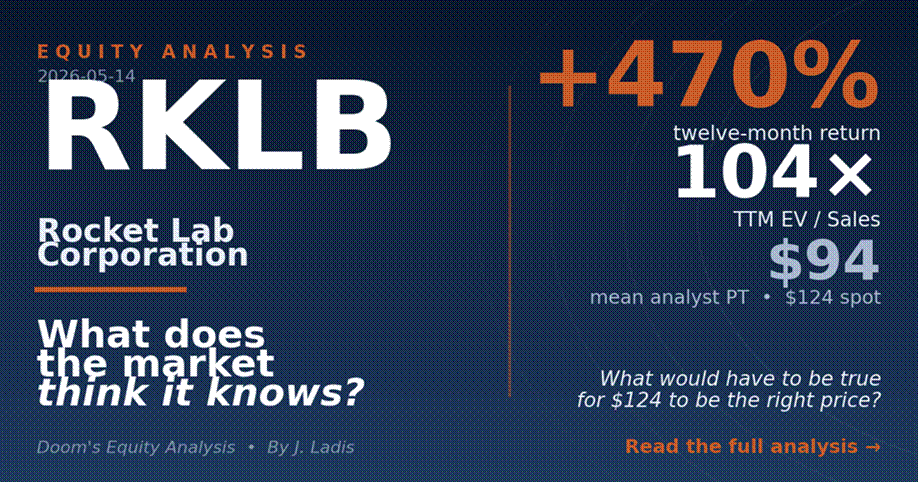
Rocket Lab at $124
What Does the Market Think It Knows?
A 470% one-year run, $72B market cap, $200M quarterly revenue, an inverted options skew that signals speculative mania, and an analyst consensus that is $30 below the stock — a structural look at what the price actually requires.
Analysis date: 2026-05-14 | RKLB close 2026-05-13: $124.39
Free preview
Rocket Lab Corporation (Nasdaq: RKLB) closed Tuesday at $124.39. Twelve months ago, the stock was $21.83. That is a 470% return in twelve months from a company that just reported its first quarter with $200 million in revenue, a record backlog of $2.2 billion, and an operating loss of $56 million.
This memo asks a single question: what would have to be true for $124 to be the right price today?
Rocket Lab is the only publicly traded vertically integrated small-launch and small-satellite company outside of the defense primes. It launches the Electron rocket roughly once a month, builds satellites and satellite components through its Space Systems segment, and is developing the medium-lift Neutron rocket — a partially reusable vehicle targeting a first flight in Q4 2026. The story has improved on every operating axis: Q1 2026 revenue grew 63% year-over-year, gross margin expanded to 38% from 29% a year earlier, the company signed 31 new launch contracts in a single quarter — more than it signed in all of 2025 — and the largest contract in company history (five Neutron flights plus three Electron flights through 2029) was announced alongside the print.
The story has improved. The price has improved more.
At $124 the equity is $72 billion; enterprise value, net of $1.07B in net cash, is roughly $70.8 billion. Trailing twelve-month revenue is $680 million. That is approximately 104 times TTM EV/Sales. The mean analyst price target across thirteen sell-side firms is $94. The highest target is $120 — still below the current price. Insiders sold roughly $135 million of stock between December and March under 10b5-1 plans (CFO Adam Spice alone sold ~$103M in January at $75.50). Basic share count grew from 530 million to 605 million between Q4 2025 and Q1 2026 alone, a 14% one-quarter increase driven by acquisition equity, convertible-note conversions, and follow-on issuance. The auditor of record is Deloitte & Touche LLP; the FY2025 opinion was clean with no going-concern modification.
Beneath the operating numbers, the trading regime has shifted from “institutional accumulation” to “speculative mania.” Options skew is inverted — calls trade at higher implied volatility than puts, the opposite of the equity-options norm. Open interest is clustered massively above spot in a textbook dealer-short-gamma profile. Top-20 institutional flow shows active growth managers distributing into passive index buying. None of that determines fundamental value; all of it determines what entering a position at $124 actually exposes you to.
The variant perception in this memo is specific and falsifiable. It is not that this is a bad company. Rocket Lab is a genuinely good operating story. The question is whether the implied trajectory required to justify $124 has a defensible base rate, and whether the asymmetry — given how much the bull case already lives in the price — has flipped against new capital.
Data Confidence: Medium-High. SEC filings and UW/Massive cross-checks corroborate on financials. Auditor identity confirmed (Deloitte). Top-20 13F institutional holders pulled. Customer concentration disclosed in aggregate (DoD/SDA dominant) but not by named customer. DEF 14A 2025 compensation for COO Frank Klein could not be retrieved (CORE coverage gap on one executive). Options positioning, momentum technicals, social-sentiment context all pulled and integrated.
Disclaimer: This analysis is informational only. The author is not a registered investment advisor. Nothing herein constitutes investment, legal, tax, or financial advice. The author may hold positions in the securities discussed and may transact in them at any time without notice. Past performance does not predict future results. Do your own work; this analysis is one input among many.
